
Amazon Affiliate Disclaimer: This post may contain Amazon affiliate links which means we may receive a commission for purchases made through links.
Introduction: What Are The Rules For The Caber Toss?
Caber toss is a traditional Scottish athletic event that has been around for centuries. It is one of the most famous events in the Scottish Highland Games, and it involves competitors tossing a large tapered pole called a caber. The caber is usually made from a larch tree and can be between 16-20 feet (5-6 metres) tall and weighs 90-150 pounds (40-70 kilograms).
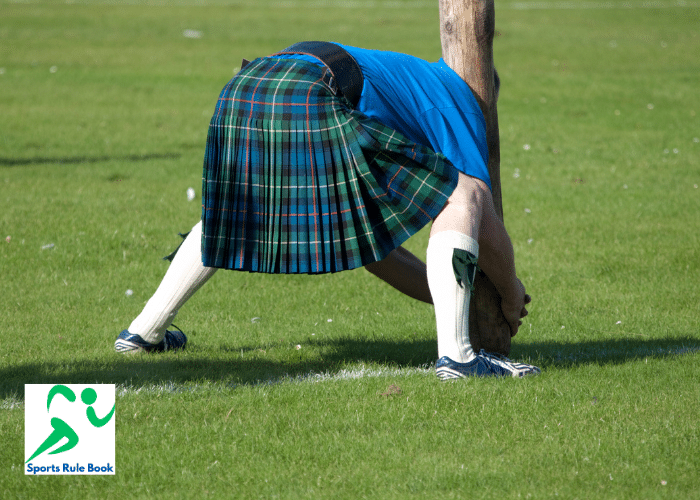
The objective of the caber toss is to toss the caber so that it turns over in the air and falls on the ground with its small end pointing directly opposite the tosser. The event requires a combination of strength, balance, and technique to be successful. The caber is put vertically upright with the whittled, smaller end of the pole facing downwards. The thrower must lift the caber and cup the small end in their hands. Once the beam is balanced, they run a short distance before tossing it so that the beam goes through one complete revolution.
History of Caber Toss
The Caber Toss is a traditional Scottish athletic event that has been around for centuries. The word “caber” comes from the Gaelic word “cabar,” which means “beam” or “pole.” The event involves competitors tossing a large tapered pole, which is usually made from a larch tree and can be between 16-20 feet tall and weighs 90-150 pounds.
The origins of the Caber Toss are unclear, but it is believed to have started as a way for Scottish lumberjacks to test their strength and skill. It was later incorporated into the Scottish Highland Games, which are a series of events that celebrate Scottish culture and heritage.
The Highland Games have been held in Scotland for hundreds of years and are now celebrated in other parts of the world, including Canada and England. The Caber Toss is one of the most popular events at the Highland Games, along with the hammer throw, sheaf toss, and casting the bar.
Over the years, the Caber Toss has evolved into a highly competitive sport, with athletes training year-round to perfect their technique. One of the most famous Caber Tossers is Danny Frame, who holds the world record for the longest caber toss at 39 feet and 6 inches.
Despite its popularity, the Caber Toss remains a uniquely Scottish athletic event, steeped in tradition and history. It is a testament to the strength and skill of Scottish lumberjacks and a celebration of Scottish culture and heritage.
Rules and Technique
Length and Weight of Caber
The caber used in Caber Toss is a tapered pole that is usually made from a larch tree. The length of the caber can vary between 16 to 20 feet (5-6 metres), and it weighs between 90 to 150 pounds (40-70 kilograms). The caber is usually carried vertically by the thrower, with the larger end on top and the smaller end on the bottom.
Run and Ground
The thrower slowly lifts the caber off the ground, cups the tapered end in both hands, and balances it against their shoulder. Once the caber is balanced, the thrower runs forward a short distance to build up momentum before tossing it. The goal is to toss the caber so that it goes through one complete revolution before landing on the ground.
Clock and Scoring
The clock is used to measure the time taken by the caber to complete one full revolution. The scoring technique is based on the accuracy of the thrower’s toss. The thrower must aim to toss the caber so that the larger end hits the ground and the smaller end flips and ends up facing away from the thrower. The angle of the caber’s landing is also taken into account while scoring.
Technique and Angle
The technique involved in Caber Toss requires the thrower to use their glutes, biceps, calves, hamstrings, and lower back muscles to lift and toss the caber. The thrower must maintain accuracy and control while tossing the caber, ensuring that it lands at the correct angle. The angle at which the caber lands is crucial to the scoring process and can make or break a thrower’s score.
In summary, Caber Toss is a traditional Scottish athletic event that requires the thrower to toss a large tapered pole called a caber. The thrower must lift the caber, balance it against their shoulder, run forward, and toss it so that it completes one full revolution before landing on the ground. The length and weight of the caber, the run and ground, the clock and scoring, and the technique and angle are all crucial aspects of the event.
Equipment and Performance
Caber and Other Equipment
The caber toss requires only a few pieces of equipment, including a caber and a throwing area. The caber is a tapered wooden pole that is typically made of larch, and it can be between 16-20 feet tall and weigh 90-150 pounds. The caber is stood upright, with the large end on the ground and the small end pointing upward. The thrower lifts the caber and runs forward before tossing it end-over-end, attempting to get the small end to land directly opposite to the thrower.
Other equipment used in the caber toss includes athletic shoes with good traction, as well as a throwing area that is at least 12 feet wide and 20 feet long. The throwing area is typically made of grass or dirt, and it should be free of obstacles or debris that could interfere with the thrower’s performance.
Partner and Momentum
In the caber toss, momentum is key. The thrower must run forward with the caber, building up enough momentum to lift and toss the pole. Many throwers use a partner to help them build momentum. The partner stands behind the thrower and pushes them forward as they begin to run, helping them to build up speed and power.
Judging and Record
In the caber toss, judges are responsible for determining the success of each throw. The caber must be lifted and tossed in a specific manner, with the small end landing directly opposite to the thrower. Judges use an imaginary clock face to determine the direction and distance of the toss, and they also take into account the angle of the caber as it lands.
The caber toss is often used as a way to establish records and determine the best performers in the sport. Records are typically kept for the longest toss and the most accurate toss, and they are often broken at Highland Games and other traditional Scottish athletic events.
Performance and Technology
While the caber toss is a traditional Scottish sport, modern technology has had an impact on the way it is performed and judged. Many throwers use video analysis to improve their technique and analyze their performance, and some events use electronic measuring devices to determine the distance and accuracy of each toss.
Despite these technological advancements, the caber toss remains a challenging and exciting sport that requires strength, speed, and precision. Whether you are a seasoned athlete or a beginner, the caber toss offers a unique and rewarding athletic experience that is sure to test your skills and push you to new heights.
Frequently Asked Questions
What is the caber toss?
The caber toss is a traditional Scottish athletic event in which competitors toss a large tapered pole called a caber. It is normally practised at the Scottish Highland Games. The objective of the game is to toss the caber in such a way that it turns end over end, with the small end landing at the 12 o’clock position, as judged by a group of officials.
How heavy is the caber?
The caber is usually made from a larch tree and it can be between 16-20 feet (5-6 metres) tall and weighs 90-150 pounds (40-70 kilograms). There is no standard size or weight of a caber, but it should be of a length and weight such that at least half the competitors can turn it.
What is the distance record for caber toss?
There is no distance record for caber toss as the event is not measured by distance, but by accuracy. The aim is to toss the caber in such a way that it turns end over end, with the small end landing at the 12 o’clock position.
How is the caber toss scored?
The caber toss is not scored by distance, but by accuracy. The judges will look at the angle of the caber when it lands and the position of the small end in relation to the 12 o’clock position. The closer the small end lands to the 12 o’clock position, the higher the score.
Who can compete in caber toss?
Anyone can compete in caber toss, but it is a physically demanding sport that requires strength, balance, and coordination. It is often practised by athletes who have a background in sports such as weightlifting, track and field, or gymnastics.
When was the caber toss invented?
The exact origins of the caber toss are unknown, but it is believed to have originated in Scotland as a way for lumberjacks to show off their strength and skill. Today, it is a popular event at Scottish Highland Games and is enjoyed by people of all ages and backgrounds.
