Amazon Affiliate Disclaimer: This post may contain Amazon affiliate links which means we may receive a commission for purchases made through links.
Introduction: What Are The Rules For Lacrosse?
Hello there, sports enthusiasts! Ever caught a glimpse of a thrilling lacrosse game and felt a sudden urge to understand this action-packed sport better? You’ve landed at the right place! In this comprehensive guide, we will unravel the intriguing game of lacrosse, digging deep into its rules, gameplay, positions, equipment, and lots more.
Origin and History of Lacrosse
Embarking on our journey, it’s vital to know where lacrosse began. This high-energy game has deep roots in Native American cultures, where it was more than a sport – it was a crucial aspect of community and spiritual life.
The Main Objective
To put it in a nutshell, the aim of lacrosse is straightforward – score more goals than the opposition. Teams work towards maneuvering a small rubber ball into the opposing team’s goal, with the aid of a long-handled stick called a “crosse.”
Lacrosse: Players and Positions
Role of Attackers
Attackers, as the name suggests, lead the offensive front. Their sharp shooting skills and agility are pivotal in putting points on the board.
Role of Midfielders
Midfielders are the “jack-of-all-trades” of a lacrosse team. With responsibilities spanning both offense and defense, their ability to swiftly transition between roles is a true game-changer.
Role of Defenders
Defenders are the guardians of the goal, putting up formidable walls to halt the opposing team’s attackers and thwart scoring opportunities.
Role of the Goalie
The goalie, often the unsung hero, is tasked with the ultimate defense – safeguarding the goal. Their quick reflexes and sharp eye for the ball are invaluable to the team.
Essential Equipment in Lacrosse
The Importance of the Lacrosse Stick (Crosse)
A crosse is more than just a stick – it’s an extension of the player’s arm. Its netted end is vital for catching, carrying, and passing the ball.
The Role of Protective Gear
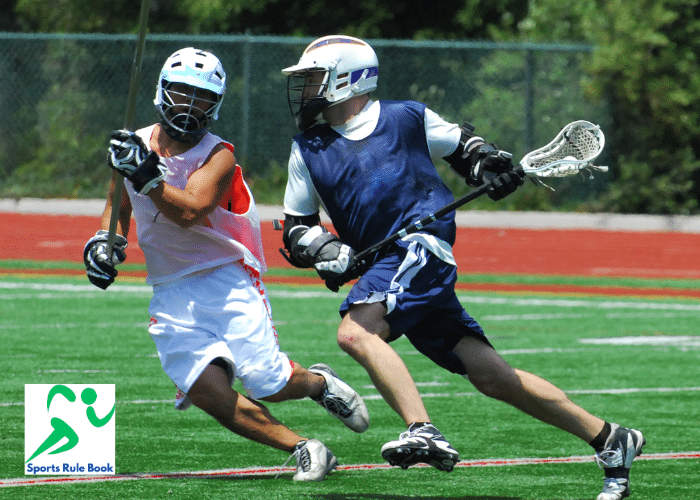
Safety first! Lacrosse players adorn helmets, gloves, shoulder pads, and elbow pads to protect themselves during the game. The goalie, being in the direct line of fire, wears additional padding.
Understanding the Lacrosse Field
Field Dimensions
A standard lacrosse field measures 110 yards in length and 60 yards in width, with goals situated at each end.
Key Features of the Field
The field is divided into sections: the attacking area, midfield, and the defending area. Additionally, the “crease” is a circle around the goal that provides a safe space for the goalie.
Understanding Lacrosse Gameplay
Starting the Game with the Face-off
Each lacrosse game kicks off with a “face-off” at the center of the field, and the ensuing tussle for ball control is always thrilling.
Techniques: Passing and Catching
Mastery over passing and catching the ball is vital for maintaining possession and creating scoring opportunities.
Scoring Goals
The ultimate aim – scoring goals. This is achieved when the ball completely crosses the plane of the goal line. Voila – that’s a point!
Offensive and Defensive Strategies
A successful team expertly balances offensive strategies (like pick and rolls, give and goes) with defensive maneuvers (such as zone defense and man-to-man marking).
Rules: Penalties and Fouls in Lacrosse
Personal Fouls
Personal fouls, including slashing, tripping, and illegal body checking, lead to time-serving penalties, giving the opposing team a man-up advantage.
Technical Fouls
Technical fouls, such as offsides or crease violations, are less severe but can still lead to a change in ball possession or a 30-second penalty.
Conclusion
Phew! That was quite the sprint through the world of lacrosse, wasn’t it? From understanding its basic rules to diving into positions, equipment, and gameplay – we’ve covered quite a bit of ground. Now, equipped with this knowledge, you’re all set to appreciate this sport on a whole new level. Who knows, you might even want to pick up a crosse and give it a go!