Amazon Affiliate Disclaimer: This post may contain Amazon affiliate links which means we may receive a commission for purchases made through links.
What Are The Rules For Squash?
What Is Squash: An Introduction
Squash is an adrenaline-fueled, fast-paced racquet sport that demands agility, strategic play, and superb hand-eye coordination. Typically played by two (singles) or four players (doubles), squash is a game that involves bouncing a ball off a wall in attempts to make it challenging for your opponent to return. The distinctive feature of this sport is its unique combination of aerobic endurance, explosive power, and mental strategy.
The Origins of Squash
Rooted in the English aristocracy, squash traces back to the 19th century. It started as a variation of the game ‘Rackets’ in the London Prison, making its way to the prestigious halls of Harrow School. Over the years, squash evolved, gaining popularity worldwide and is now played in over 185 countries.
Squash Equipment
Playing squash requires specific equipment that conforms to the standards of the World Squash Federation (WSF). Here’s what you need to know.
Squash Racquet
Squash racquets, unlike those in tennis or badminton, have a smaller head and long neck. They’re light, usually weighing between 110 to 170 grams, making them maneuverable for quick volleys and precise shot-making.
Squash Ball
A squash ball is small, rubber, and weighs just 23 to 25 grams. They come in varying speeds (denoted by colored dots), with beginners usually starting with a blue or red dot ball that bounces more, and progressing to a double yellow dot ball – the competition standard.
Squash Court
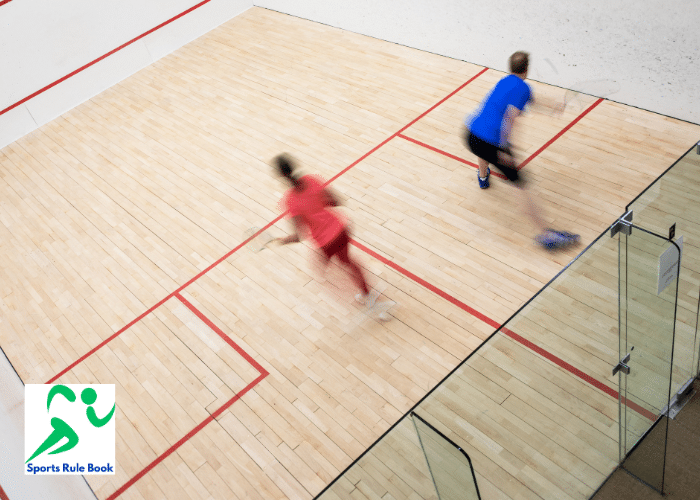
A squash court is a four-walled arena with a door in the middle of the back wall. The front wall features several parallel lines indicating specific play areas. The dimensions of a standard court are 6.4 meters wide and 9.75 meters long.
Basic Rules of Squash
Here’s a simple breakdown of squash’s fundamental rules.
The Service
Serving in squash requires the server to stand in either service box, bouncing the ball once before striking it onto the front wall. The ball must land above the bottom line (the service line) and below the top line on the front wall and then hit the ground beyond the middle line in the opposite back quarter.
The Scoring System
Squash adopts a hand-in-hand-out scoring system or point-a-rally scoring system. In the former, only the server can score points, while in the latter, every rally can result in a point for either player. Games usually go up to 9 or 11 points, with matches being the best of 5 games.
In-Play Rules
Players take turns hitting the ball onto the front wall above the board and below the outline. The ball is allowed to hit the side walls but must not hit the floor before reaching the front wall. A rally continues until a player fails to return the ball, hits it out, or a fault occurs.
Out of Play Rules
Squash is not just about hitting the ball; it’s also about fair play and safety. If a player obstructs their opponent from playing a fair shot, it can result in a let (the rally is replayed), or a stroke (the obstructed player wins the rally).
Advanced Squash Techniques
Elevating your squash game involves mastering various techniques.
Serve Techniques
Different types of serves like the lob serve, body serve, or attacking serve can be used to catch the opponent off guard and gain an early advantage in the rally.
Stroke Techniques
Strokes in squash include drives, volleys, drops, boasts, and lobs, each with its own strategic purpose. Mastery of these strokes can give a player significant control over the game.
Tactical Play
Tactics in squash revolve around controlling the T (the intersection of the mid-line and the short line near the center of the court). It involves understanding opponent weaknesses, varying shot selection, and dictating the pace of the game.
Mastering Squash: How to Improve Your Game
Improving your squash game involves more than just understanding the rules and techniques. It requires consistent practice, fitness conditioning, and mental strategy.
Tips and Tricks
From maintaining a strong grip on the racquet, perfecting your swing, practicing footwork, to staying fit and developing mental toughness – the list is endless.
Squash Training Resources
Several resources, including online tutorials, books, coaching clinics, and squash clubs, can help you up your game and compete with confidence.
Conclusion
Squash is an exhilarating sport that offers a thrilling blend of physical exertion and strategic gameplay. Understanding its rules, mastering the techniques, and improving fitness are keys to shining on the squash court. Now, it’s time to pick up that racquet and start playing!
Frequently Asked Questions
-
What is the best way to start learning squash? Starting with a coach or joining a squash club is the best way to learn. They will guide you through the basic rules and techniques, ensuring a strong foundation.
-
How long does a typical squash match last? A squash match varies in duration, but on average, it lasts around 45-60 minutes.
-
Can squash be played alone? Yes, solo practice is common in squash and is a great way to improve your shots and movements.
-
What is the ‘T’ in squash? The ‘T’ is the central intersection of lines on the squash court from where a player can reach any part of the court quickly. It’s the ideal position to control the game.
-
Why are there different colored dots on squash balls? The colored dots on squash balls denote their speed and bounce. Beginners usually start with a blue or red dot ball (more bounce), progressing to a double yellow dot ball (competition standard).